
Lithium for batteries dominates the debate. Yet very specific lithium streams are becoming critical for advanced nuclear.
Natural lithium (7.5% Li-6 and 92.5% Li-7) is perfectly fine for EVs because only chemical purity matters, not isotope ratio.
However, isotopes are considered differently in the nuclear sector
▶️ In fission, Li-7 is used in 2 places: in fluoride molten salts such as FLiBe for some advanced reactors, and as lithium hydroxide in small amounts to control coolant chemistry in PWRs.
▶️ In fusion, both Li-6 and Li-7 will help produce tritium, the fuel that keeps deuterium-tritium machines running. Li-6 in particular. These uses need extremely pure lithium and very specific isotope ratios. Enrichment is not needed when Lithium is used only for thermal, chemical, or plasma-surface purposes for some specific fusion designs.
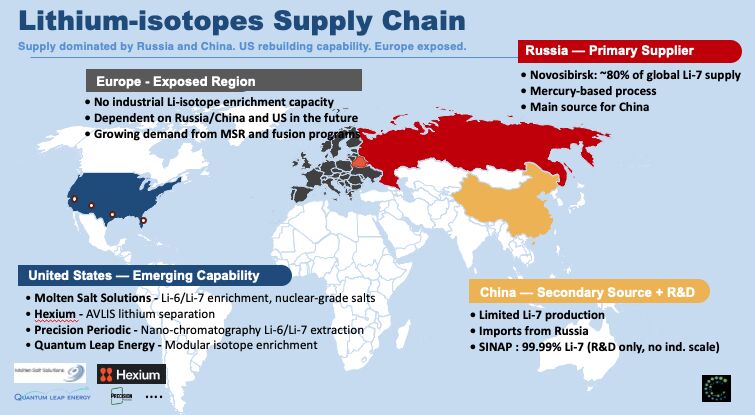
🇷🇺 🇨🇳 Enriching lithium is difficult and dominated by Russia+China. Li-6 and Li-7 behave almost identically chemically, and the only industrial-scale process ever operated, COLEX, used mercury and was banned in the US decades ago. Today almost all enriched Li-7 comes from TVEL’s NCCP plant in Novosibirsk, which supplies up to 80% of global demand.
🧪 Of course, there is R&D on this topic. The atomic-vapour laser isotope separation (AVLIS) process could offer small-scale Li-7 enrichment for PWRs, while crown-ether liquid-liquid extraction is the most promising larger-scale option identified so far for MSR salts. SINAP in China demonstratedd centrifugal and counter-current extraction reaching 99.99% Li-7 at lab scale, but no clean industrial-scale replacement for the old COLEX process exists yet…
🇺🇸 A small set of US-based specialist companies is now trying to rebuild a domestic capability:
– Molten Salt Solutions proposes Li-6 and Li-7 enrichment and nuclear-grade fluoride salts using a liquid-liquid extraction process developed with Los Alamos. Raised about $3M in late 2024 for a pilot (400–1000 kg per year).
– Hexium emerged from stealth in 2025 with roughly $12M to advance AVLIS.
– Precision Periodic develops a nano-chromatography technology with support from the DoE to scale a high-volume, zero-waste process.
– Quantum Leap Energy (QLE) uses modular isotope-enrichment systems targeting Li-6, Li-7 and other advanced fuels. Signed an MoU with Fermi America to co-develop a nuclear-fuel facility in Texas.
🇪🇺 Europe, however, still has no industrial Li-isotope enrichment capacity even if, on the demand side, developers like copenhagen atomics explicitly plan to use highly enriched Li-7 fluoride for their thorium molten-salt reactor.
As nuclear evolves, the supply chain will not be defined only by reactor OEMs. Other small, deeply technical companies producing narrow, high-spec materials such as enriched lithium salts will also have a key role to play…
Please do not hesitate to share your comments on this topic that I am still investigating!
This short article is only an introduction to the subject. To get an in-depth analysis of this topic or adjacent topics, get in touch and check the list of services that we can provide